
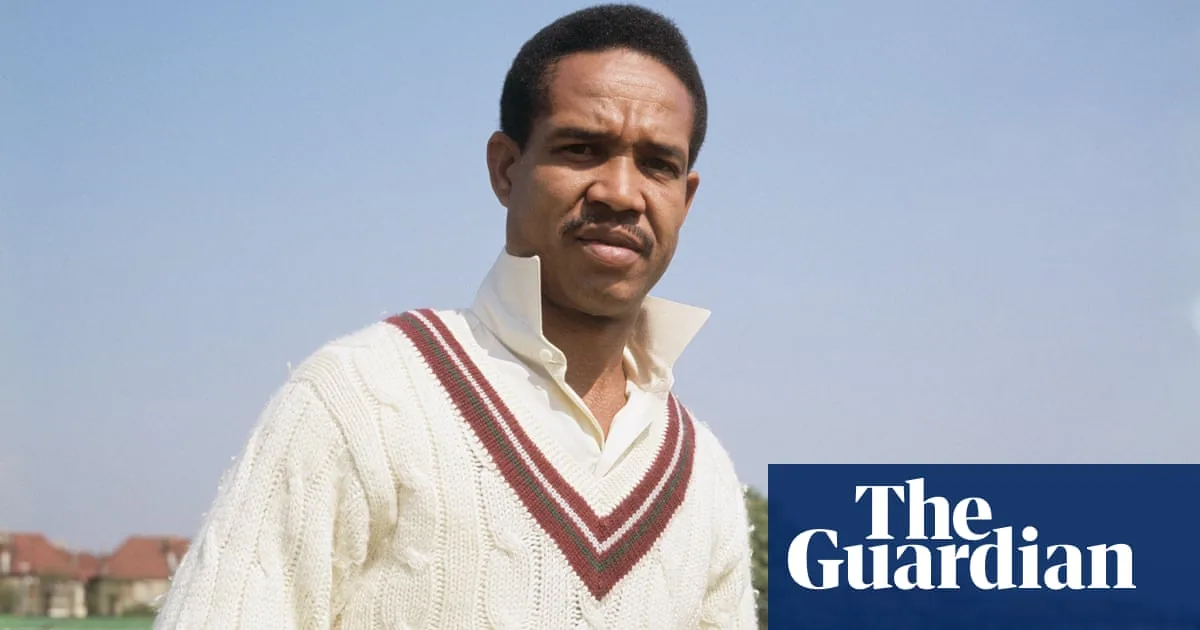
Sir Garfield Sobers, who recently passed away at the age of 89, is widely regarded as one of the greatest all-rounders in cricket history. A national hero in Barbados, his illustrious Test career spanned two decades, and he was knighted following his retirement. Beyond the West Indies, Sobers is also remembered for his time playing for Nottinghamshire in England, where he achieved a historic feat by becoming the first player to hit six sixes in a single over in a professional game.
Sobers was a multi-talented sportsman long before the modern emphasis on versatile cricketers. He was a powerful left-handed middle-order batter and an athletic fielder, excelling as a close catcher. His bowling was particularly remarkable, as he was capable of delivering left-arm fast-medium, orthodox left-arm spin, and left-arm wrist-spin, often switching styles within the same innings. This versatility made him an invaluable asset, effectively combining the roles of several players into one.
Early life and career beginnings
Born Garfield St Aubrun Sobers in Bridgetown on 28 July 1936, his childhood was marked by the loss of his merchant seaman father during World War Two when Sobers was just five years old. His mother, Thelma, raised him and his five siblings. Sobers, who was born with an extra finger on each hand that were removed in childhood, showed early promise in various sports.
His cricketing journey began in his early teens when he was recruited for local club cricket. He made his first-class debut at 16 against touring Indian players at Kensington Oval in his hometown, a ground where the pavilion would later bear his name. In that match, playing for a strong Barbados side, he batted at number nine and took four wickets in the first innings and three in the second.
Just 14 months after his first-class debut, Sobers, then 17, made his Test debut in early 1954 against England in Jamaica. He was called upon to replace the ill Alf Valentine, the Windies’ regular left-arm spinner, and again captured four wickets on debut. Initially, he batted at number nine, a position he would not occupy again in Test cricket.
Despite the presence of established middle-order batters like the ‘Three W’s’ – Clyde Walcott, Everton Weekes, and Frank Worrell – Sobers was moved up to number six in his next Test appearance during Australia’s 1955 tour. He quickly demonstrated his all-round capabilities, notably hitting the first three balls he faced from Keith Miller for four during an emergency opening stint in the fourth Test.
His first tour of England in 1957 saw him score one half-century in five Tests, but he illuminated Trent Bridge with an unbeaten 219 against Nottinghamshire, his future county side.
Breaking records and leadership
Sobers’ first Test century came in his 17th match, four years into his career, but it was a record-breaking performance. Against Pakistan at Sabina Park in Jamaica, he shared a 446-run second-wicket partnership with Conrad Hunte. When the West Indies declared on 1 March 1958, Sobers, still only 21, was 365 not out. This score surpassed Len Hutton’s previous record of 364 set in 1938 and remained a record until 1994. This innings marked the beginning of a prolific period for Sobers, as he scored five more centuries in his subsequent five Tests. With improvements in his seam bowling, he became the leading all-rounder of the 1960s.
His talent was in high demand, leading him to play for Radcliffe in the Central Lancashire League from 1958 to 1962, and for Norton in the North Staffordshire and South Cheshire League from 1964 to 1967. His success during the 1960-61 season in Australia also led to an invitation to play for South Australia in the Sheffield Shield for three seasons.
In 1965, Sobers succeeded Frank Worrell as captain of the West Indies. In the English summer of 1966, he led his team to a 3-1 series victory, contributing 722 runs, three centuries, and 20 wickets himself. He also captained Rest of the World XIs against England and Australia when South Africa was in sporting isolation. However, he faced criticism for participating in a double-wicket competition in Rhodesia in 1970, for which he later apologised.
His move to Nottinghamshire in 1968, following the abolition of residential qualifications for overseas players, saw him become a hero in the East Midlands. It was during his first season with Notts, on 31 August 1968, that he achieved his most famous record: hitting six sixes in an over off Glamorgan seamer Malcolm Nash at Swansea. This moment was captured by a camera crew and remains a celebrated part of cricket history. This record has only been matched once in first-class cricket, by Ravi Shastri in 1985.
Legacy and enduring impact
Sir Donald Bradman, after witnessing Sobers’ double century for the Rest of the World against the Australians in Melbourne in 1972, described it as potentially the greatest exhibition of batting ever seen in Australia. Trevor Bailey, a contrasting all-rounder and friend, wrote a biography of Sobers in 1976, stating that Sobers was “quite simply, the greatest of all time, the most complete all-rounder ever.”
Sobers’ Test career statistics include 8,032 runs at an average of 57.78, with 26 centuries, and 235 wickets at an average of 34. He played two more Test series against England under his successor, Rohan Kanhai, before concluding his first-class career at the end of the 1974 county season.
His approach to the game was often described as cavalier, playing with a joyous freedom that set him apart in his era. He famously declared in Trinidad in 1968, setting England 215 to win in 165 minutes, a decision that caused a stir but reflected his desire for exciting cricket. Sobers’ legacy as an extraordinary talent and a captivating player continues to be celebrated.
Source: bbc.co.uk