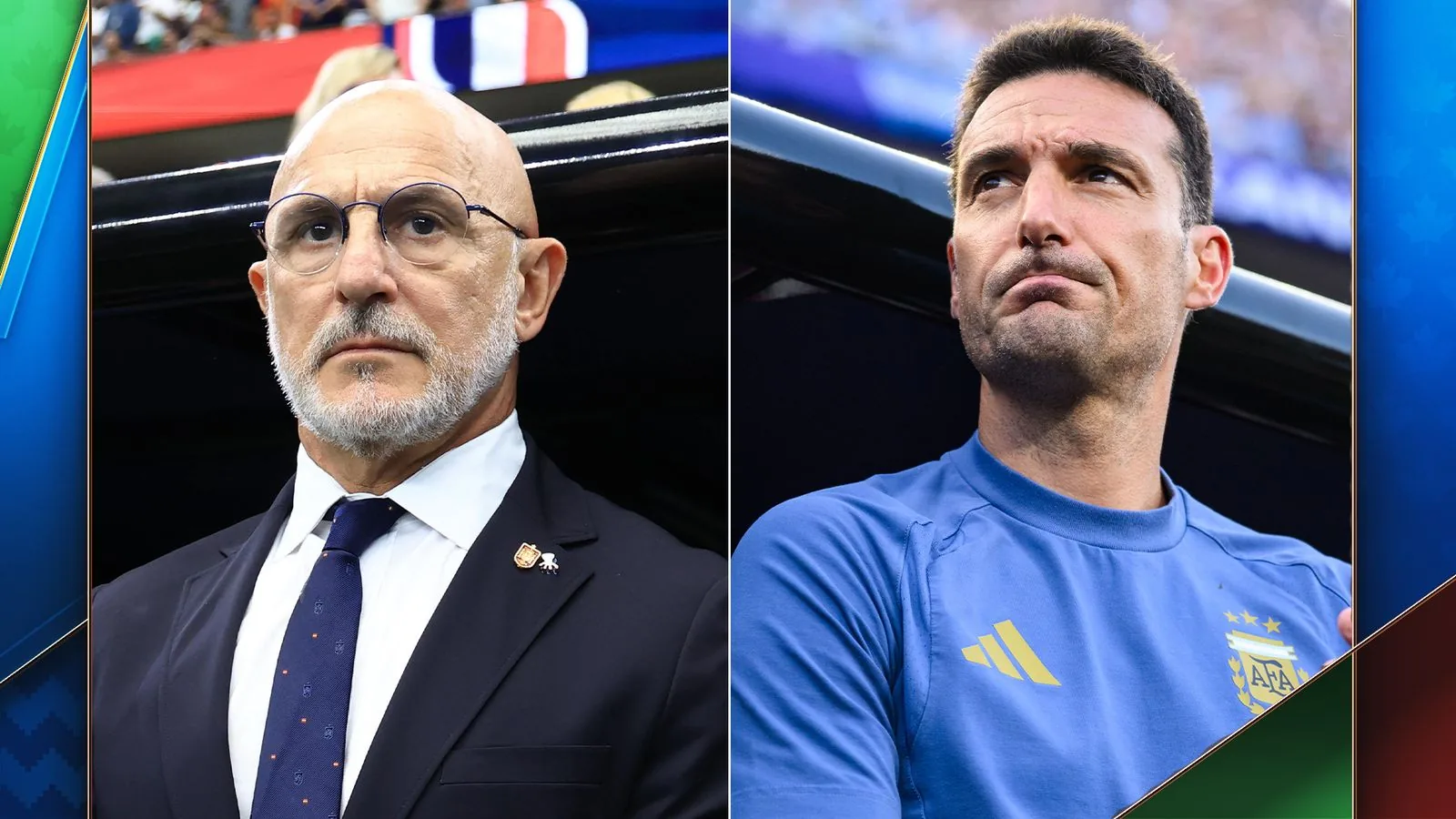
The upcoming World Cup final will feature a contest between Spain and Argentina, led by managers Luis de la Fuente and Lionel Scaloni, respectively. Both coaches have guided their national teams to the final despite not having managed top-flight club games. Their success contrasts with the performance of other high-profile managers in the tournament.
Lionel Scaloni took over Argentina when the team had not secured a major tournament win in 25 years. Since then, he has led them to three consecutive major international trophies, including the previous World Cup and the Copa America. His appointment as manager followed a period as assistant to Jorge Sampaoli in 2018.
Similarly, Luis de la Fuente, who was promoted from Spain‘s U21 team, aims to add a World Cup title to the country’s recent successes. He previously led Spain to a European Championship triumph in 2024 and clinched the Nations League just six months after replacing Luis Enrique in 2023. De la Fuente has a long history with the national youth setup, having coached Spain‘s U19s and U21s for a decade.
Managerial Approaches and Team Dynamics
The paths of Scaloni and De la Fuente to the World Cup final highlight a different approach to international management compared to some of their peers. Their success has been built on fostering strong team spirit and relationships with their players. De la Fuente, for instance, has emphasised a ‘family’ atmosphere within the squad, benefiting from his extensive experience with many of the players from their youth careers. Rodri, now Spain‘s captain, was part of De la Fuente‘s European Championship-winning U19 team in 2015.
Scaloni, who also had a brief stint as Argentina‘s U20s coach, is known for his tactical flexibility and ability to adapt to different opponents. Players like Alexis Mac Allister and Javier Mascherano have praised his clear ideas and adaptability. Argentina‘s collective spirit is also a notable aspect of their success under Scaloni, with players like Nicolas Otamendi and Emi Martinez highlighting his man-management skills and the equal treatment of all squad members.
The contrasting styles of play between the two finalists are expected to make for an intriguing match. Spain is known for its possession-based game, focusing on intricate passing and creating scoring opportunities through sustained ball control. Rodri is central to this approach, dictating the tempo from midfield.
In contrast, Argentina is characterised by a more aggressive and passionate style, prioritising physical play and attempting to unsettle opponents. This tactic was evident in their semi-final match against England, where they aimed to disrupt the rhythm of England‘s key players. Lionel Messi remains a pivotal figure for Argentina, often making the difference in critical moments.
High-Profile Managers’ Struggles
The success of Scaloni and De la Fuente stands in contrast to the struggles of several high-profile club managers who took on international roles for the World Cup. England‘s Thomas Tuchel, formerly of Borussia Dortmund, Paris Saint-Germain, Chelsea, and Bayern Munich, was eliminated in the semi-finals. His tactical decisions, particularly in the second half of the semi-final, have drawn criticism.
Julian Nagelsmann, who previously managed Hoffenheim, RB Leipzig, and Bayern, left his role with Germany after their round of 32 exit. Carlo Ancelotti, a five-time Champions League winner, did not guide Brazil past the last 16. Mauricio Pochettino‘s USA team also exited at the same stage, and Marcelo Bielsa‘s Uruguay failed to advance past the group stage.
These outcomes raise questions about the relevance of club-level pedigree in international management, suggesting that different qualities might be required for success on the global stage. Scaloni and De la Fuente, despite their more modest club coaching backgrounds, have demonstrated that fostering unity, tactical flexibility, and strong player relationships can be key to triumph in international tournaments.
Political Banner Incident
During Argentina‘s semi-final celebrations, a political banner was unfurled by players, including midfielder Giovani Lo Celso and center-back Lisandro Martínez. The banner, which read “LAS MALVINAS SON ARGENTINAS” (The Malvinas (The Falklands) are Argentine), refers to the British-ruled Falkland Islands, a long-standing point of contention between the United Kingdom and Argentina.
The incident could lead to action from FIFA, as the organisation’s Stadium Code of Conduct prohibits banners of a political, offensive, or discriminatory nature. Law 4 of the Laws of the Game also bans political messaging. Previous instances of political banners have resulted in sanctions, such as South Korea‘s Park Jong-woo being banned for two international matches in 2012 and Spain‘s Rodri and Álvaro Morata receiving one-match bans in 2024.
The final match on Sunday will see Lionel Messi, who currently leads the tournament’s scoring charts with eight goals and two assists, face Spain‘s young talent Lamine Yamal, who is considered by many to be a potential successor to Messi‘s legacy.
Source: cnn.com