
Tournament overview and controversies
The recent World Cup, hosted across the United States, Mexico, and Canada, was described by Fifa president Gianni Infantino as potentially the “biggest event in the history of mankind.” The tournament expanded to include 48 teams for the first time, with nations such as Curacao, Cape Verde, Jordan, and Uzbekistan making their debuts. This expansion aimed to bring new storylines and colour to the group stage, with Cape Verde, a nation of 530,000 people, achieving notable draws against Spain and Uruguay.
Despite the spectacle, the tournament was not without controversy. High ticket prices drew criticism, and Fifa faced a subpoena from attorneys general in New York and New Jersey regarding ticket pricing and seat accuracy. Additionally, initial bans on supporters bringing water bottles into grounds were reversed after public backlash. Immigration policies also presented challenges, with supporters from several nations reportedly unable to enter the country due to US travel bans, and Somali referee Omar Artan was refused entry at Miami Airport.
The treatment of Iran was highlighted as a significant issue, with the US administration allowing the team into the country for a limited time around each of their three fixtures. The tournament also saw a notable incident involving Folarin Balogun, whose ban was suspended for months, allowing him to play against Belgium. This decision, made by a member of the Fifa disciplinary committee, raised questions about political interference.
Rule changes and their impact
Several rule changes were implemented during the World Cup, including mandatory three-minute hydration breaks in every match, regardless of conditions. While Fifa stated these breaks were for player welfare, they also provided opportunities for broadcasters to air commercials. Coaches utilised these breaks for tactical discussions, which reportedly influenced the course of several matches.
Pierluigi Collina, Fifa‘s head of referees, introduced measures to improve the tempo of games, focusing on quicker throw-ins, goal-kicks, and substitutions, and reducing delays from apparent injuries. These changes resulted in an average match length of 96 minutes 24 seconds, with a ball-in-play time of 58 minutes 15 seconds. This represented a slight increase in ball-in-play time compared to the 2022 World Cup, where the average match length was 101 minutes 22 seconds and ball-in-play time was 58 minutes three seconds.
A new seeding policy was also introduced to prevent top-ranked countries from facing each other early in the knockout rounds. Argentina, England, France, and Spain were given special status to be drawn into separate quarters of the draw, aiming to ensure that the top two ranked countries, Argentina and Spain, could not meet until the final. This involved swapping Argentina into Group J and France into Group I.
Tournament outcome and player performances
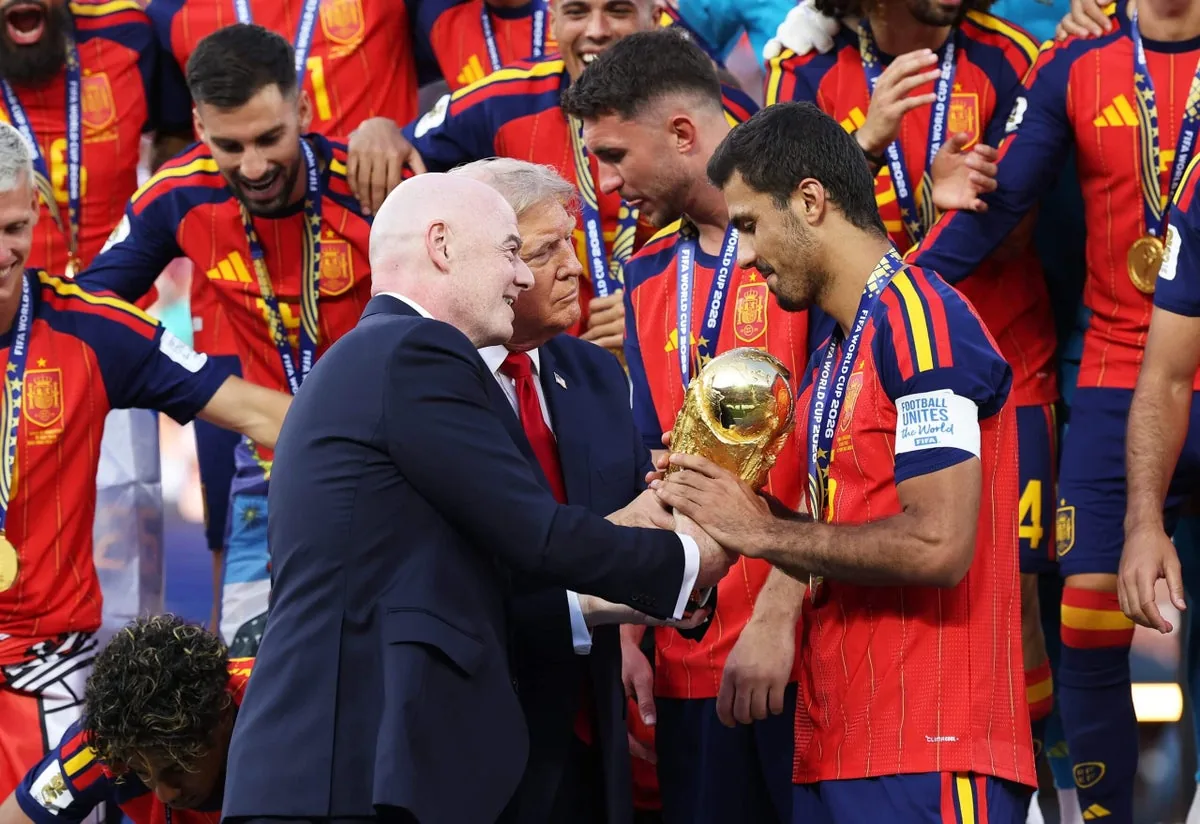
The tournament culminated in Spain winning the title. Many observers considered Spain to be the best team, highlighting their consistency and dominant performances, particularly their defensive masterclasses in the final two matches. Despite being held to a draw by Cape Verde in their opening game, Spain improved throughout the tournament.
Individual performances also garnered attention. Lionel Messi was frequently cited as a standout player of the tournament. His ability to carry the Argentina team at an advanced age was widely praised. Kylian Mbappe, who won the Golden Boot, and Rodri, who captained Spain, were also recognised for their exceptional contributions.
The quarter-finals were noted as less inspiring, while Argentina‘s semi-final win over England was thrilling.
The World Cup generated a record attendance of 6,527,410 fans, with stadiums operating at nearly full capacity at 99.7% after the quarter-finals.
Source: theguardian.com