
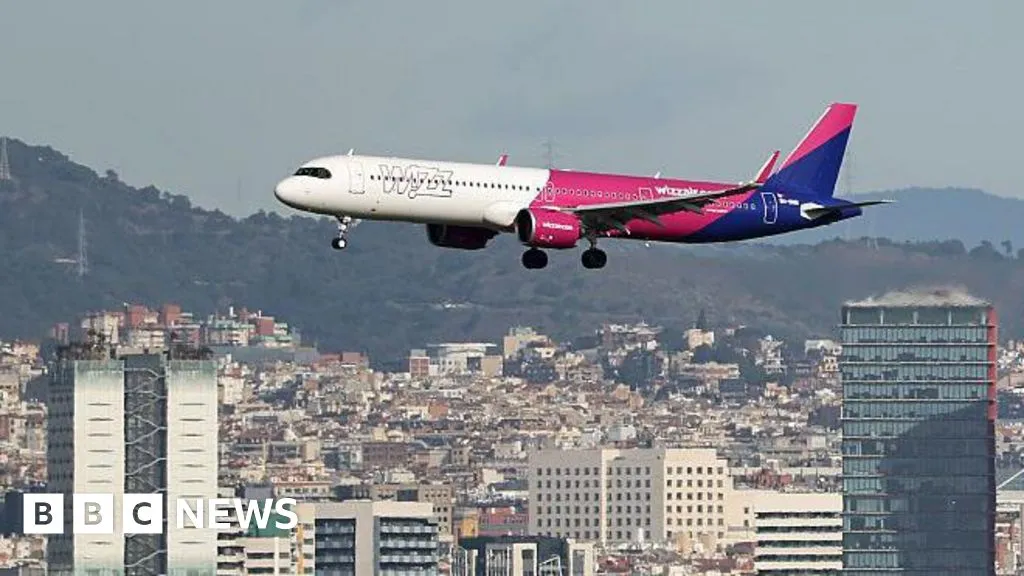
In a bold statement that echoes through the tumultuous skies of the airline industry, Wizz Air’s CEO, József Váradi, has confidently dismissed claims of impending bankruptcy made by Ryanair’s chief, Michael O’Leary. With rising fuel prices threatening to destabilize many carriers, Váradi insists that Wizz Air is well-prepared to soar above these challenges.
The backdrop of this assertion is a world grappling with fluctuating oil prices due to ongoing geopolitical tensions—most notably, the conflict in Iran which has severely restricted shipments through the Strait of Hormuz. This disruption has sent shockwaves through the market, causing jet fuel prices to spike. Yet Wizz Air stands firm: they have hedged an impressive 70% of their fuel needs for the summer at a mere $700 per metric ton—significantly lower than the market price of approximately $1,700.
Váradi’s confidence was palpable when he stated, “I don’t think we’re going to be running out of fuel.” His optimism is backed by strategic planning; Wizz Air anticipates a summer schedule that is 17% larger than last year’s. This growth reflects not only operational stability but also a proactive approach to navigating turbulent economic skies.
In contrast, O’Leary has warned that if oil prices remain elevated, two or three European airlines could face bankruptcy—specifically naming Wizz Air among them. However, Váradi countered these assertions directly: “O’Leary’s recent comments about Wizz Air’s financial prospects are flatly untrue and false.” His rebuttal underscores a broader trend within the airline sector where competition and survival hinge on effective risk management.
To further bolster their position, Wizz Air’s Chief Commercial Officer Ian Malin revealed that the carrier has hedged 86%, 71%, and 61% of its fuel needs across the first three quarters of 2026 respectively. This strategy places Wizz Air in a more favorable light compared to Ryanair, which has hedged around 80% of its needs but at higher costs.
The airline boasts a liquidity ratio exceeding that of its competitors, with cash reserves amounting to an impressive €2 billion. This financial cushion provides Wizz Air with significant leverage as they navigate uncertain waters ahead. Despite O’Leary’s fears of potential bankruptcies within the sector, Váradi remains steadfast in his belief that alternative solutions for jet fuel will emerge—”Jet fuel traders will find alternative solutions, other sources. I don’t see disaster coming,” he declared.
The future remains fraught with uncertainty as global fuel prices continue to fluctuate unpredictably. Observers note that while Wizz Air appears well-positioned for now, the overall health of European airlines hangs delicately in balance amid these rising costs.